

The Splenic is the body’s oldest awareness — the intelligence of survival, of the immediate present, of the quiet knowing that arrives faster than thought. It is one of three Awareness Centers in the BodyGraph, and the first form of awareness to evolve in human beings.
This is the awareness of instinct, of intuition, of the immune system’s constant reading of the world. Its voice is quiet, brief, and never repeats itself.
Where It Sits
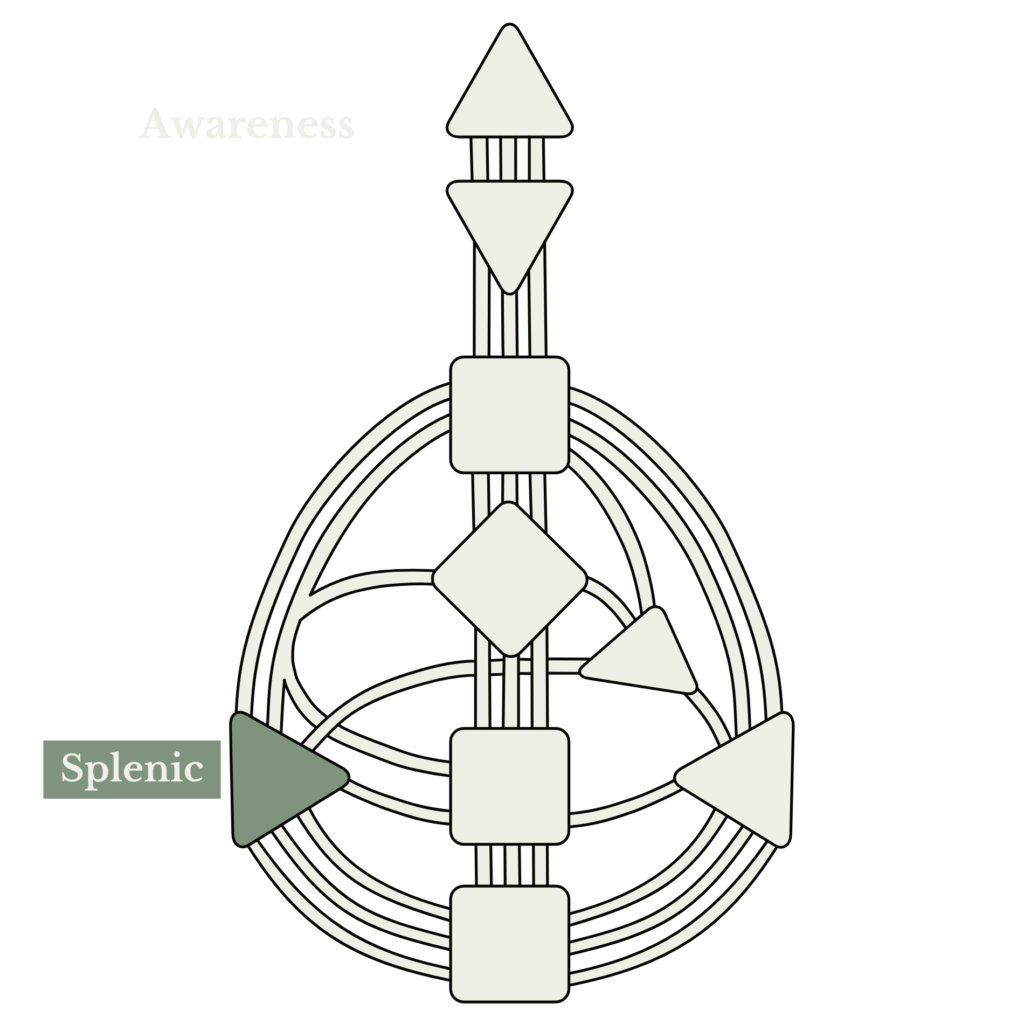
The Splenic Center is the triangular shape on the left side of the BodyGraph, pointing toward the center. It sits next to the Sacral and below the Throat. Look for it on the left side of the figure’s lower torso.
What It Does
The Splenic is the first form of awareness to evolve, and it lives deeply in the body. It is the intelligence of instinct, intuition, and the immune system’s constant reading of what is safe and what is not.
Splenic knowing operates in the now. It speaks once and only once — in a single moment — and then it moves on. If you miss it, you miss it. It will not repeat itself. This is the awareness that tells you, quietly, that something is off before you have any reason to know why. It is the hunch that saves you from a decision you couldn’t have logically rejected. It is also the source of the body’s sense of wellbeing — the spontaneous joy, playfulness, and lightness that arise when the system feels safe and alive.
Because the Splenic is tied so closely to survival, it communicates in a language of warning as well as welcome. What people often experience as fear — especially the deep, wordless, in-the-body fears that seem to arise from nowhere — is the Splenic doing its work. These fears, when they are genuine and not absorbed from others, carry information. They are not obstacles to overcome. They are the body’s awareness reporting what it has noticed.
In the Body
The Splenic Center corresponds to the spleen itself, the lymphatic system, and the body’s immune function. Biologically, this is the intelligence of the immune system — the cells and processes that are constantly reading the environment to determine what nourishes and what threatens.
When Splenic awareness is strained or overridden, the body often speaks first. Resilience weakens. Susceptibility to illness increases. The system has to work harder just to stay stable. Honoring the Splenic is not an abstract practice — it is a material matter of the body’s ongoing health.
The Three States
When the Splenic is defined. If your Splenic is colored in, you have a consistent, reliable source of in-the-moment knowing. Definition here means that the quiet voice of instinct is always available to you — though whether you have learned to hear it, or have been conditioned away from hearing it, is a different question.
People with defined Splenics often have a strong immune constitution. They tend to feel good in their bodies, in a way that can be invisible to them precisely because it is consistent. The Splenic’s messages — the sudden no, the quiet yes, the sense of something is off here — are threaded through their awareness as a steady background presence.
The challenge for a defined Splenic is that its messages are brief and singular. They arrive once. The mind, wanting more certainty, can easily override them or second-guess them into silence. Honoring a defined Splenic means trusting what the body knew in the moment it knew it — even when the mind wants to argue.
When the Splenic is undefined. If your Splenic is white but contains one or more dormant gates, it is undefined. An undefined Splenic does not have a consistent internal voice of instinct. Instead, it takes in the survival signals, health patterns, and existential fears of those around it, amplifying them.
The felt experience of an undefined Splenic is often a kind of low-grade uncertainty about what is genuinely safe and what isn’t. Fears can arrive without clear origin. Attachments can form and persist past the point of genuine nourishment — to people, places, jobs, beliefs — because letting go activates a survival-level alarm that feels like I cannot let this go and still be safe. Much of this is not a personal failing. It is the mechanics of the openness.
The challenge of an undefined Splenic is the pull to hold on — to the familiar, the established, the known — even when the familiar is no longer healthy. The body reads holding-on as safety and letting-go as threat, whether or not that’s the actual truth of the situation.
When the Splenic is completely open. A completely open Splenic is white and contains no dormant gates at all. The full range of Splenic signals arrives, but without any particular flavor. Without dormant gates to give survival signals a consistent shape, the person may not know what to be afraid of — which can tip toward either generalized anxiety or a fearlessness that takes genuine risks with the body. Both patterns come from the same source: the absence of familiar hooks that would normally direct the awareness toward specific areas of attention.
The Splenic is the body’s oldest knowing, and one of its most reliable when it can be heard. Knowing what state yours is in is the beginning of being able to recognize when your body is speaking to you and when it is reflecting the survival signals of someone else.
This post is one of nine in a series exploring each of the energy centers in your Human Design chart. For an overview of all nine centers and how they work together, start here: The Nine Energy Centers: A Complete Guide →
You can get your free Human Design chart in about two minutes. And when you’re ready to move beyond knowing your design intellectually — to actually feeling it in your body and your daily experience — Design Illuminated is where that journey goes deeper.