
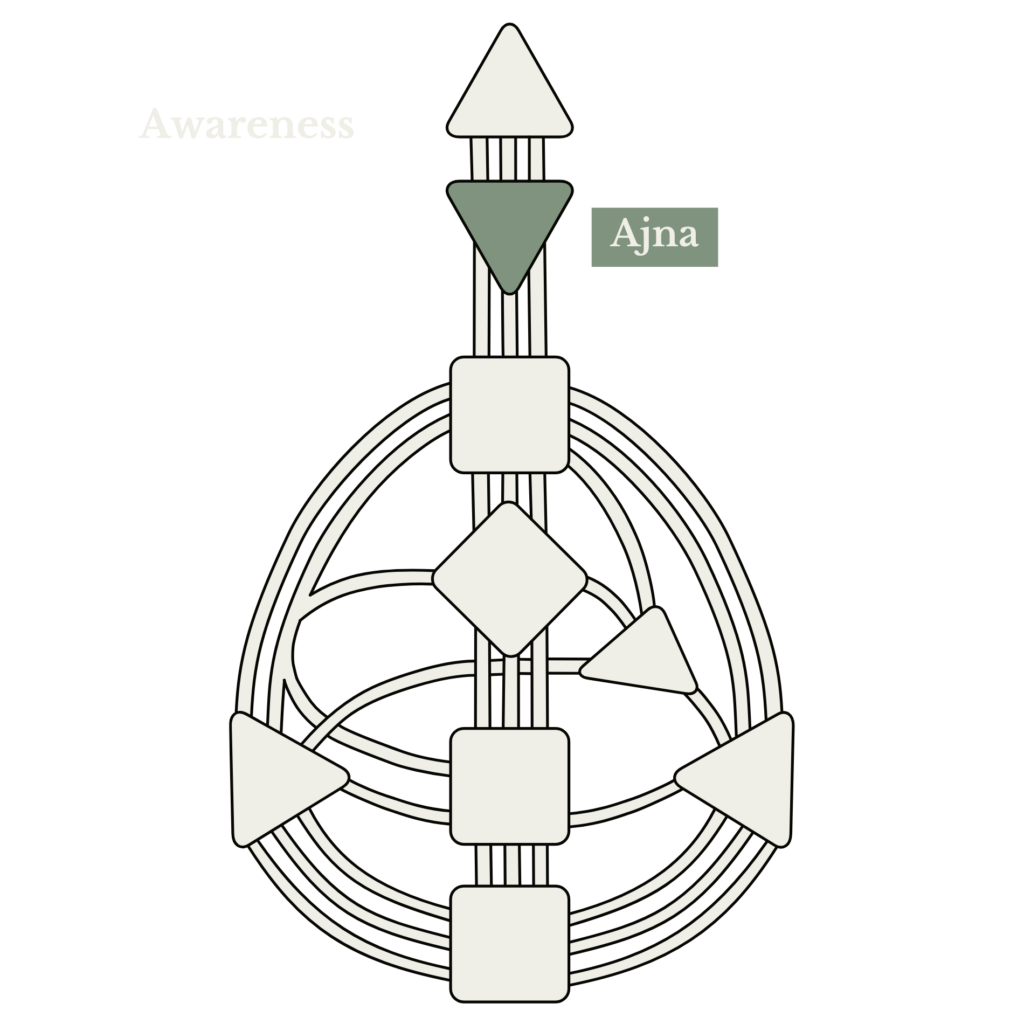
Head gets processed, interpreted, and turned into ideas, opinions, and understanding. It is the second of three Awareness Centers in the BodyGraph, and the form of awareness most of modern culture has come to rely on.
It is also one of four centers that can never serve as your Authority. The Ajna is brilliant at analyzing. It is not built for deciding.
Where It Sits
The Ajna is the triangular center just below the Head, pointing downward into the Throat. It is the second of the three centers stacked at the top of the BodyGraph — Head, Ajna, Throat — that together form the architecture of inspiration, thought, and expression.
What It Does
The Ajna is the second form of awareness to evolve, and it is the awareness most of modern culture has come to rely on — perhaps to its detriment. This is the mind’s capacity to conceptualize, to hold opinions, to map out frameworks, to construct meaning from experience. It is the territory of science, philosophy, religion, and all the systems of understanding that hold human societies together.
Ajna awareness works through duality. It weighs this against that. It can hold two opposing viewpoints simultaneously and explore the merits of each. What it cannot do is determine which is correct for you. That kind of knowing lives elsewhere in the system. The Ajna can analyze endlessly — but analysis is not Authority, and the Ajna, like the Throat, the Head, and the Root, can never serve as your decision-making guide.
This is an important piece of mechanical truth. The Ajna is a brilliant interpreter. It is not a brilliant decider. When we try to use it for decisions, we end up in loops of reasoning that never quite resolve, because the mind’s nature is to keep weighing rather than to conclude.
In the Body
The Ajna Center corresponds to the anterior and posterior pituitary glands and is deeply connected to the mental nervous system. Biologically, this is the intelligence of the brain’s interpretive layer — the processing that turns raw inspiration into usable thought.
When Ajna awareness is under strain, the mental nervous system often carries the weight. Thoughts intensify. Perception can feel crowded, loud, or difficult to quiet. Tension accumulates in the head, jaw, neck, and shoulders. The strain of over-identifying with mental activity becomes a bodily experience, not just a psychological one.
The Three States
When the Ajna is defined. If your Ajna is colored in, you have a consistent and reliable way of processing information. Your mental patterns are your own. The particular gates and channels of your defined Ajna create a fixed way of thinking — logical, abstract, individual — that is recognizably you, regardless of whose field you’re in.
People with defined Ajnas are steady thinkers. They hold opinions that don’t easily shift, and this stability can be a genuine gift in a world that often rewards whoever shouts loudest. Their minds are theirs. Their frameworks hold.
The challenge for a defined Ajna is the mind’s always-on quality. It does not stop. It can be hard to meditate, hard to rest mentally, hard to simply not be thinking about something. And because the thinking is fixed, a defined Ajna can become overly attached to its own frameworks — convinced that its way of seeing is the way, rather than one way among many.
When the Ajna is undefined. If your Ajna is white but contains one or more dormant gates, it is undefined. An undefined Ajna does not have a fixed way of thinking. It is open, fluid, and capable of holding many perspectives at once — which is a genuine gift, though the culture around it rarely sees it that way.
The challenge of an undefined Ajna is the pressure to be certain. In a world that prizes confident, consistent opinions, a mind that naturally sees all sides can feel inadequate. The not-self mind often compensates by pretending to certainty — borrowing the convictions of others and performing them as if they were one’s own. When the person with the defined Ajna leaves the room, the borrowed certainty evaporates, and the open Ajna is left wondering why it can’t seem to hold a steady position.
Learning that you don’t need to be certain — that your design is built for genuine flexibility, for real openness to new information, for the capacity to shift your thinking as new understanding arrives — is some of the most liberating work available to an undefined Ajna.
When the Ajna is completely open. A completely open Ajna is white with no dormant gates at all. The full range of mental processing can move through, but without any particular flavor or framework. This can leave a person genuinely uncertain about what to think or how to organize the thoughts that arrive. In a culture that expects everyone to have opinions, this can feel like a deficit. It isn’t. It’s a design feature that, when met with peace rather than pressure, allows for remarkable openness to many kinds of thinking.
The Ajna is where the mind does its most distinctive work. Knowing what state yours is in is the beginning of being able to use your mind as a tool rather than a master — and to stop asking it to do what it was never built to do.
This post is one of nine in a series exploring each of the energy centers in your Human Design chart. For an overview of all nine centers and how they work together, start here: The Nine Energy Centers: A Complete Guide →
You can get your free Human Design chart in about two minutes. And when you’re ready to move beyond knowing your design intellectually — to actually feeling it in your body and your daily experience — Design Illuminated is where that journey goes deeper.