
The G Center, also called the Self Center, is the seat of identity, direction, and love. It is the only Identity Center in the BodyGraph, and it sits at the very heart of the figure — the place where the self, in the deepest sense of that word, lives.
It is not a motor, not a pressure center, not an awareness center, not a manifestation center. It is something else entirely.
Where It Sits
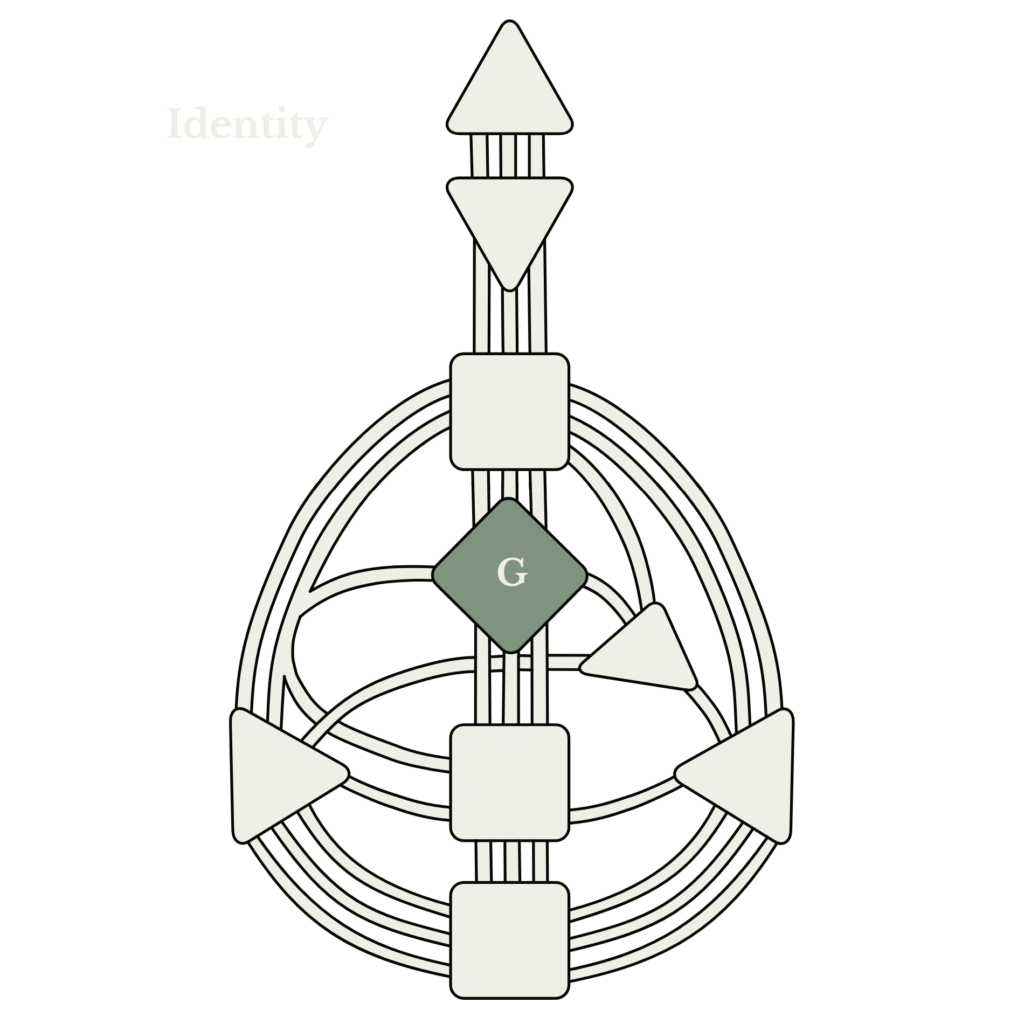
The G Center is the diamond-shaped center in the middle of the BodyGraph. It sits at the center of the figure, with energy flowing into it from many directions and out from it toward many others. Its central position reflects its function: the G is the place from which identity, direction, and love radiate, and the place toward which much of life is drawn.
What It Does
The G holds your sense of who you are, the direction your life is moving, your capacity for love, and the orientation by which you find your way through the world. It is responsible for both identity and trajectory — both who you are and where you are going.
At the very center of the G Center lives what Human Design calls the Magnetic Monopole. The Monopole is described as a single-pole magnet — and unlike the magnets we know in the physical world, which always have two poles, this one only attracts. What it attracts is the life that is correct for you: the people, the places, the encounters, the love, and the experiences that belong to your particular path.
The teaching here is profound and quiet: you do not have to find your life. Your life is being drawn toward you, one correct decision at a time. Your work is to live according to your design — to follow your Strategy and Authority — and let what is yours arrive.
In the Body
The G Center corresponds to the liver and the blood. Biologically, this is the territory of the body’s deepest filtration and circulation systems — the liver that processes everything we take in, the blood that carries nourishment and oxygen to every cell.
When the G is strained — when a person is living in a place that doesn’t suit them, in relationships that don’t honor who they are, on a path that doesn’t reflect their truth — the body often registers it through the liver and the blood. Liver function suffers. Energy depletes. The deeper systems of physical vitality begin to falter. Honoring the G is not abstract. The body knows when you are in the right place and with the right people, and it knows when you are not.
The Three States
When the G is defined. If your G is colored in, you have a fixed and reliable sense of identity. You know, in some essential way, who you are — and that knowing does not shift based on the company you keep or the environments you find yourself in. People with defined Gs tend to carry a recognizable signature of self. Others can feel it. There is a steadiness, a continuity, a sense of here is who this person is.
A defined G also tends to have a clearer internal sense of direction — not always a clear destination, but a felt sense of this is the way I am going, even when the path itself is uncertain.
The challenge for a defined G is the assumption that everyone has this same fixed quality. A defined G can imagine that others should know who they are, should have a clear sense of direction, should not feel lost or untethered. The defined G’s particular gift is steadiness; the work is to remember that steadiness is not the only valid way to be.
Unlike the other centers, the Defined G has a unique vulnerability that’s essential to understand in order to live out the consistent identity, direction, and connection to Higher Source that it provides. Read More →
When the G is undefined. If your G is white but contains one or more dormant gates, it is undefined. An undefined G does not have a fixed sense of identity. It is fluid, adaptive, and deeply influenced by the people and the places it inhabits.
The felt experience of an undefined G is often a chronic, low-grade question: who am I really? The mind, looking for a stable sense of self, may search relentlessly for an identity it can hold onto — through career, through relationships, through spiritual or psychological frameworks, through the search for a true self that the undefined G is not actually designed to find in that fixed form.
The teaching for an undefined G is that identity, for this design, is not a thing to be found. It is a thing to be allowed. In the right environments and with the right people, the undefined G adapts and reflects in ways that feel like genuine self-expression. In the wrong environments, the same person can feel profoundly lost — not because something is wrong with them, but because the place itself is wrong.
This makes place uniquely important for the undefined G. The teaching is direct: if you are in the wrong place, you are with the wrong people. The undefined G’s well-being depends on being in environments — homes, workplaces, neighborhoods, even particular rooms — that are correct.
When the G is completely open. A completely open G is white and contains no dormant gates at all. The full range of identity-related energy moves through, but without any particular flavor. A completely open G can feel especially untethered in a culture that demands fixed identities and clear directions. Without dormant gates to give the openness even a particular flavor, the person may feel that they have no self at all — or that their self changes so profoundly from one context to another that no through-line is visible.
The G Center is the heart of your design — the place from which your sense of self emanates and toward which your life is drawn. Knowing what state yours is in is the beginning of being able to live in the kind of relationship with your own identity that your design actually intends.
This post is one of nine in a series exploring each of the energy centers in your Human Design chart. For an overview of all nine centers and how they work together, start here: The Nine Energy Centers: A Complete Guide →
Read about a little-understood vulnerability of the Defined G Center →
You can get your free Human Design chart in about two minutes. And when you’re ready to more deeply connect to your design and discover ways to live in alignment with your True Self, you can arrange a one-to-one private session.