

The Channel of Emoting (39-55) and the Channel of Openness (22-12)
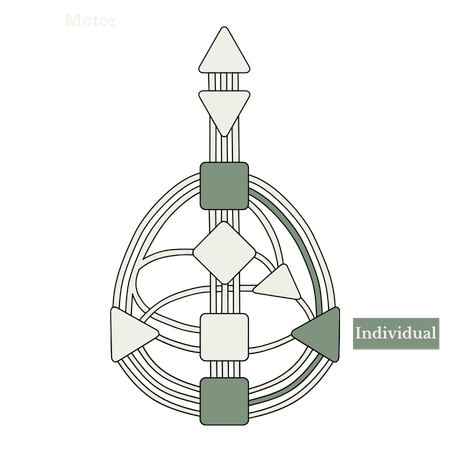
The Individual Emotional Wave form is the one that spends most of its time on an even keel — long stretches of level water broken by sudden, shorter spikes: up into passion, down into melancholy, and back to level again. The mood arrives seemingly out of nowhere, colors everything while it lasts, and then, on its own, it shifts. It’s a wave about mood itself, and about the creativity mood is always quietly inviting.

- It moves along an even keel, broken by shorter spikes up into passion and down into melancholy.
- The mood arrives on its own timing and shifts on its own — it isn’t caused, and it can’t be reasoned away.
- Knowing when to withdraw to the creative muse is what lets the mood do its real work.
The Solar Plexus Center sits in the lower right of the BodyGraph, and when one of these two Individual channels colors it, your emotional life organizes itself around mood: the passing weather of melancholy and passion, and the way that weather opens or closes you to the world.
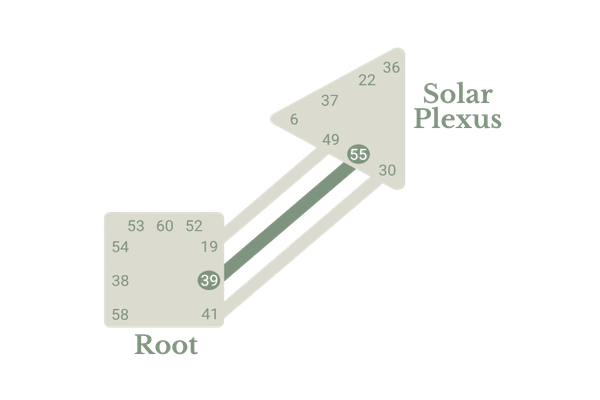
The Channel of Emoting (39-55) is moodiness itself. It begins in the Root Center, where Gate 39 provokes — stirring the spirit to find out what it truly feels — and moves toward the Solar Plexus Center, where Gate 55 holds the full spectrum of mood, from the depths of melancholy to the heights of joy. This is the channel that feels the mood most rawly, as pure emotional weather with no particular subject. The provocation is the fuel; the mood is where it surfaces. Society tends to read this as a flaw — why are you so moody — but that reading has it exactly backward, and we’ll come to why.
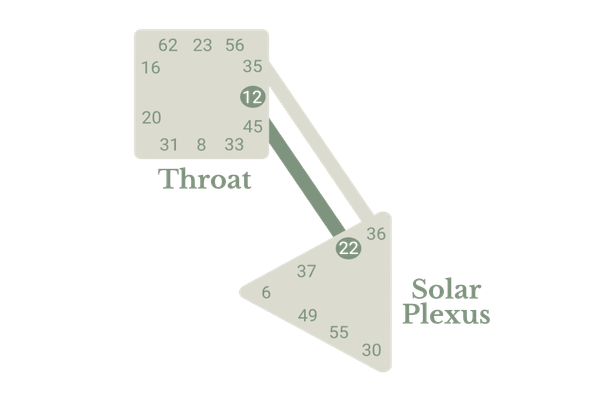
The Channel of Openness (22-12) carries the same Empowerment wave toward expression. It runs from the Solar Plexus Center, where Gate 22 opens you socially — graceful, listening, present — toward the Throat, where Gate 12 governs whether the feeling gets voiced or held. This is the social being whose openness comes and goes with the mood: warm and available when the mood is right, quiet and withdrawn when it isn’t. The caution of the 12 is not shyness; it’s the throat waiting for the mood that makes the words true. Where 39-55 is the mood generated, 22-12 is the mood surfacing — or wisely staying unspoken until its moment.
Across the pair, then, the current runs Root to Solar Plexus to Throat: provocation, mood, voice. One channel stirs the weather; the other decides whether and when it speaks.
What both channels share is that this wave answers to a more inward kind of other than the other two. The Tribal wave rises around the people you belong to; the Collective wave rises around a vision or an experience. The Individual wave can rise and fall about something no one else set in motion — an inner weather, a private melancholy, a passion that belongs to you alone. It’s still relational, because to be conscious is to be in relationship — but here the wave is most its own, most internally generated, least explained by anything outside you.
Left unaware, the cycle tends to run like this:
- A mood rises — a spike of melancholy, seemingly without cause.
- You treat it as a problem: something must be wrong, with you or with someone near you.
- You try to talk yourself out of it, or push through and stay social when the mood is asking you to withdraw.
- Unhonored, the mood leaks sideways — surfacing as blame, or landing on whoever happens to be closest.
- It passes, as it always would have — but now there’s residue: a sense that you did something wrong, or that they did.
- The next spike arrives, and the same story runs again.
Here is the reframe this wave most needs, and it’s the heart of the post. The moodiness is not a flaw to be corrected. It’s the voice of wisdom — the form emotional truth takes for this design. The trouble common Human Design language points to, where a mood is used to “victimize” others, isn’t the mood’s fault; it’s what happens when a mood goes unattended and gets projected outward as blame. Attune to it, respect it, give it room, and it stops leaking sideways — not because you’re managing yourself for other people’s sake, but because a mood that’s honored has no need to be weaponized. Honoring the mood and sparing the people around you turn out to be the same act, not a trade-off between them.
And the mood, at both poles, is an invitation. Melancholy invites you inward, toward the reflective, quiet kind of making; passion invites you outward, toward the expressive kind. The creative muse lives at both ends of the spike. So the “release” for this wave isn’t something you do to the mood — it’s right relationship with its timing: knowing when to step away from the social world and be alone with what the mood is offering, and trusting that the weather will shift when it’s ready. You don’t discharge this wave. You keep faith with it.
Now picture a small boat on a mostly calm sea — level water, and then a sudden swell of passion or a sudden trough of melancholy, and then level again. From the crest you see one thing; in the trough, another; on the flat between them, another still. None of these is the view. But ride enough of them, and something almost mysterious happens — out of the whole collection of perspectives, emotional clarity arrives. You don’t figure out what to do. You gather, and the way shows itself once you’ve let the mood move through its full range, the low as honest as the high. The wave brings these perspectives at their own pace — that’s the work of the Emotional Authority itself.
One thing shapes how this unfolds. Whether the gates forming your channel are conscious or unconscious changes how the wave shows up. Conscious activations you can often feel coming — you possess the ability to see the mood as it’s erupting. Unconscious ones run as body before the mind catches them, so you tend to recognize the mood only by looking back over where you’ve just been. For a wave whose spikes arrive this suddenly, that’s especially worth knowing. Neither is better; the perspectives gather either way. The awareness that helps is simply knowing which direction to look.
And this is the reframe the standard teaching tends to miss: the wave is not a constraint placed on you. It is you. For an emotionally defined person, this even keel broken by moodiness is simply the form clarity takes — not an obstacle between you and clarity, but the shape clarity arrives in. You will never not be subject to your moods, and that is not a defect. The richness was never only in the calm; it’s in every point, the melancholy and the passion alike. And when clarity comes, it reveals only enough to move you into the next wave — not a final arrival, but the next step. That’s not a limitation. That’s the design working exactly as it should.
There’s even a quiet gift in the waiting. When you stop overriding your moods — stop faking the sociability the mood didn’t have, stop forcing the making the mood wasn’t ready for — what remains is the work and the company that actually matches your rhythm. The creative projects that survive your honest tempo are the ones that were yours to make. The people who stay easy with your weather are the ones who belong alongside it. Honored, the mood filters your life for genuine fit.
So the next time a mood rises and you feel the pull to fix it, explain it away, or act on its spike — try answering, I’ll feel about this. Not I’ll think about it. Let the mood move at its own pace. Let it show you where the muse is inviting you.
The other emotional wave forms — Need, Desire, and Intimacy — each move in their own shape and bring their own kind of clarity. Together they make up the four emotional waves.
Read about the 4 types of Emotional Waves →
Read about the Tribal Wave, Need →