
Profile in Human Design
The costume you’re wearing this time

Your Human Design chart tells you where your energy is defined, how you’re meant to make decisions, and how your energy field is structured. Your Profile tells you about how this shows up in your life. Where your chart and bodygraph tell you the character you’ve chosen to play in this incarnation, your Profile tells you how your character is dressed.
For example, maybe your character is that of a money magnate but your costume looks like a hermit who at times tries a lot of experiments, other times is withdrawn, and then in the end, wears the robes of a wise sage.
What’s here for you
- What it felt like to learn mine
- How your Profile is created
- The six Lines
- Themes of the Lines
- The lived experience of the Profiles
- The technical specs
- The three geometries
- Where the angle comes from
- Where to find the angle on your chart
- Read yours
Or, just skip ahead and read about the individual Profiles here →
What it felt like to learn mine
When I first read that my Profile was 3/6, my reaction was immediate and mixed. I loved the idea of being a “Role Model.” I did not love the word “Martyr.” I’d grown up around a version of martyrdom that looked like quiet suffering and importance — someone convinced she’d given everything and gotten nothing back for it because the divine wanted her to purify herself through pain. This, layered on top of a Catholic-school upbringing rife with stories of saints suffering nobly because it was a blessing from on high, the word landed hard.
It took me a while to separate the label from what the Line actually described. The 3rd Line isn’t about suffering to prove itself worthy, or like Job, to prove its fealty. It’s about learning by bumping into the world — making a commitment, finding out it doesn’t work, and adjusting, over and over, until something finally does. There’s no failure in that process, only data. That shift transformed how I saw my own first three decades, which had been painfully turbulent compared to many others around me. I’d spent a long time judging, blaming, and shaming myself for that chaos. Once I understood it as the correct operation of a 3rd Line — not proof that I’d done something wrong — I released myself from my inner purgatory.
The 6th Line felt much more welcome. This was the state of grace I’d always yearned to live in. Of course, the actual 6th Line experience is much messier than that. It felt fortunate to me that I learned about it long after having reached the third phase. Looking back, I could easily identify the 3rd Line life for the first 30 years. Particularly as a 3/6, it was a double 3rd Line life which meant that the intensity of the chaos and damage now made sense. The second phase from 30 to 50 was only a partial retreat because of that omnipresent 3rd Line. But, as much as I could, I had retreated from the trainwreck phase of life and experimented with a less traumatic way of living. With a palpable sigh of relief, I could see that I was in the third and final phase of a 6th Line’s experience and that let me know that I was never going to find myself back in that nightmarish circus of my first thirty years. I also could freely experience gratitude for all of the churning and burning because it, correctly, provided the straw that can become the gold of my life.
This is the real richness of learning your Profile. It doesn’t hand you a new personality. It offers you permission to stop judging, blaming, or shaming the one you already have.
How your Profile is created
Profile is determined by two positions in your chart: the Line of your conscious Personality Sun and Earth (the part of you that’s aware and identifiable) and the Line of your unconscious Design Sun and Earth (the part that’s simply running in the background, shaping you in ways you rarely notice until someone points them out).
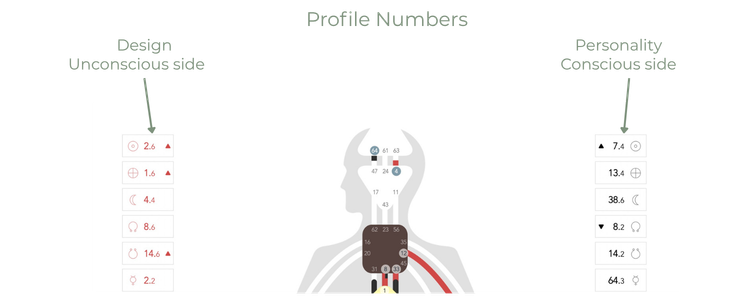
What’s interesting is, you don’t have to know your Profile in order to express it in your life. It’s simply there, shaping how you learn, how you bond with people, how you handle being seen. Known or unknown, it shows up and if you don’t understand why you have particular themes of relating, or not relating, your conditioned not-self mind can make up stories about you. If you have a 3rd Line in your Profile, it may be very common for you to make and break bonds. But if you don’t know that, you can take on criticism from others, and even more from yourself. Instead, when you understand that this is a natural aspect of having a 3rd Line in your Profile, and you are experimenting with following your Strategy and Authority, those bonds made and broken won’t bring resistance, judgment, blame, and shame.
Each Sun and Earth activation sits on one of six Lines, creating twelve possible combinations — twelve Profiles. It appears as two numbers, like 3/6 or 2/4.
The 6 Lines
The six Lines form a hexagram and are split into two groups of three, and the difference between these bigrams tells an important part of the story.
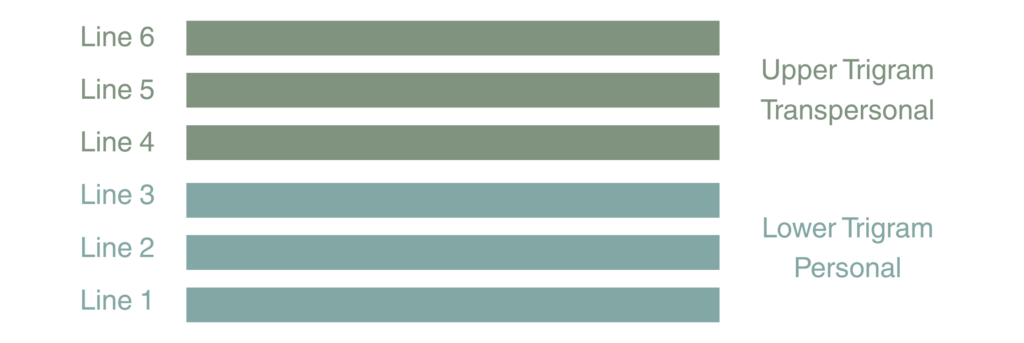
Lines 1 through 3 in the lower bigram are personal. They’re concerned with you. These lines focus on your own foundation, process, and discoveries. A chart with both Lines in this range (there’s only one — the 1/3) is entirely self-referential; its business is building an inner foundation through investigation and direct experience, and that business doesn’t require anyone else’s participation.
Lines 4 through 6 in the upper bigram are transpersonal. They’re concerned with your effect on others through your network, your reputation, and the role you model whether you’re conscious of it or not. A Profile drawing from this range is never fully private; other people are built into the mechanics of how it operates.
Nearly all of the Profiles are a combination of the energies of the two bigrams — one Line from the personal range, one from the transpersonal. In those cases, your conscious and unconscious elements of your Profile can feel like it’s pulling you in two directions at once. That tension, where it exists, provides contrast and richness. Having both lines in the same bigram isn’t free of tension or easier. It simply creates a unique orientation to Life.
Themes of the Lines
Line 1 — the foundation-seeker, known as the Investigator. Needs to understand something deeply before it feels safe to move. Insecurity shows up as under-preparation; security comes from research, study, and eventually becoming an authority in its own right.
Line 2 — the natural, known as the Hermit. Has innate gifts that simply exist without having been sought or acquired. Normally doesn’t even see them, particularly in the same way others do. Needs real time alone, and needs to be called out by the right person before those gifts get shared.
Line 3 — the discoverer, known as the Martyr. Learns by doing, and very often by getting it wrong first. Bonds get made and broken, not out of instability but because that’s how this Line finds out what actually holds up. There’s no such thing as a wasted mistake here — only information.
Line 4 — the networker, known as the Opportunist. Influence flows through relationships that come naturally and through friendships, not through strangers. Stability comes from a trusted circle; opportunity and the ability to be influential come from within it.
Line 5 — the one who gets projected onto, known as the Heretic. Possesses an aura that energetically causes people to believe that this person can solve their problem. That belief is a gift and a genuine vulnerability — deliver, and the reputation grows; disappoint, and it collapses fast.
Line 6 — the one who lives it in three parts, known as the Role Model. Spends roughly its first three decades experimenting similar to a Line 3. Next, it climbs up to observe and integrate for a couple of decades. Finally, it re-emerges around fifty as a living example of accumulated experience, having discovered what’s worth passing on as wisdom.
The lived experience of the Profiles
Learning about your Profile is helpful, however the most valuable insights lie in seeing how you experience it. Get your free Human Design Insight chart and custom report that includes your specific info. Or, you can read about each one.
- 1/3 — Investigator Martyr, Read More →
- 1/4 — Investigator Opportunist, Read More →
- 2/4 — Hermit Opportunist, Read More →
- 2/5 — Hermit Heretic, Read More →
- 3/5 — Martyr Heretic, Read More →
- 3/6 — Martyr Role Model, Read More →
- 4/6 — Opportunist Role Model, Read More →
Stay tuned
- 4/1 — Opportunist Investigator
- 5/1 — Heretic Investigator
- 5/2 — Heretic Hermit
- 6/2 — Role Model Hermit
- 6/3 — Role Model Martyr
The technical specs
If you like taking a deeper dive into the more technical aspects of the system, you can learn more about the Profiles’ substructure here.
Special Note: The images and information below that demonstrate the geometry and mechanics of the angles is not necessary for you to begin to experience and observe how your particular Profile operates in your life. The most important place for you to focus your awareness is on what themes the lines in your Profile offer and whether or not you recognize them.
The 3 geometries
Every Profile also belongs to one of three larger patterns, based on how its two Lines relate to each other. It often seems more complex than it is. Simply put, some are here to learn about themselves in the presence of others; some learn through others and how they are affected by them. And a very small percentage are here to live as they’re meant to without being affected by others.
Right Angle Profiles — the seven Profiles built from two Lines both in the 1–4 range, or two overlapping ones — are personal. They’re here to live their own life and work out their own questions; other people cross their path without redirecting it. They fulfill their purpose in self-exploration.
Left Angle Profiles — the four built from higher-numbered Line combinations — are transpersonal. Their path genuinely depends on intersecting with other people’s; a connection can shift their direction in a way it wouldn’t for a Right Angle Profile. They can’t fulfill their purpose in isolation.
Juxtaposition is its own category, held by a single Profile: the 4/1. It’s neither personal nor transpersonal — more like a fixed track, moving in one direction regardless of who gets on board. This Profile comes into contact with others but its trajectory isn’t changed, rather anyone who remains in their sphere becomes a part of the 4/1’s destiny.
It’s worth separating this from Right Angle, since both get described as “unaffected by others” and that’s not quite the same claim. Right Angle means you’re the author of your own story — free to move, choose, and revise course through your own trial and error, while other people pass through without becoming co-authors. Fixed Fate means there’s no story to author in the first place. The track is already set, and anyone who stays in a 4/1’s orbit long enough gets pulled onto that track too — a pull Right Angle Profiles simply don’t have.
Where the angle comes from
If your mind works like mine and the word “angle” conjures up an image of a cosmic protractor out in space measuring it all, good news. There sort of is. Your Design activations are calculated at roughly 88° of solar arc before your birth, about three months earlier on the 64-gate Mandala wheel.
Measured in gates, that 88° usually lands your Design activation exactly 16 hexagrams from your Personality activation — a quarter of the wheel, a genuine right angle. When that gap shifts by one gate instead, landing 15 or 17 hexagrams apart, the angle tips into Left Angle territory. The 4/1 sits at the exact hinge point where that shift happens, which is why it’s the only Juxtaposition Profile.
You can see in the examples below how subtle the change is visually. However, the influence of the location on the hexagram of the conscious gate’s line relative to the unconscious gate’s line is what makes all the difference.
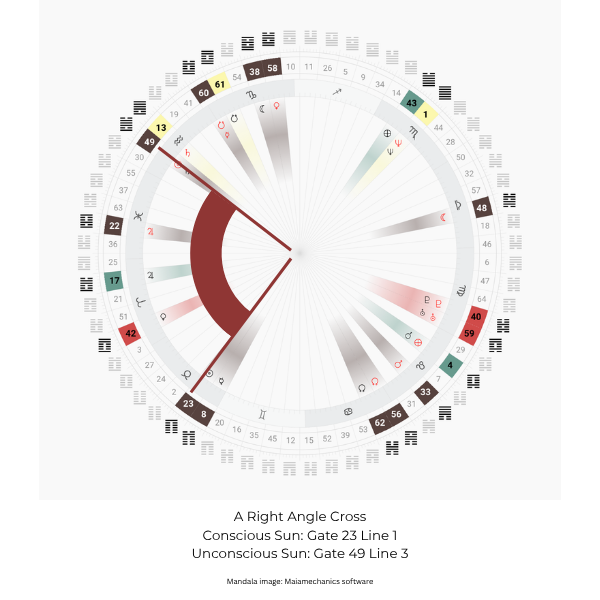
The Right Angle Cross is created by the 1/3, 1/4, 2/4, 2/5, 3/5, 3/6, and 4/6 Profiles.
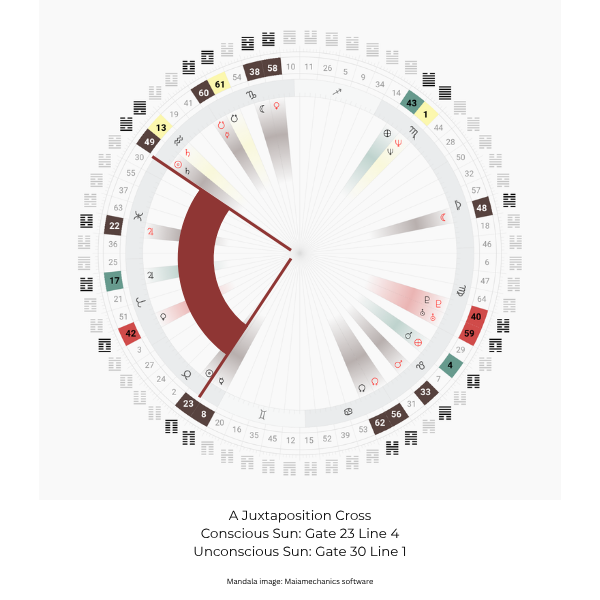
The Juxtaposition Cross is created only by the 4/1 Profile.
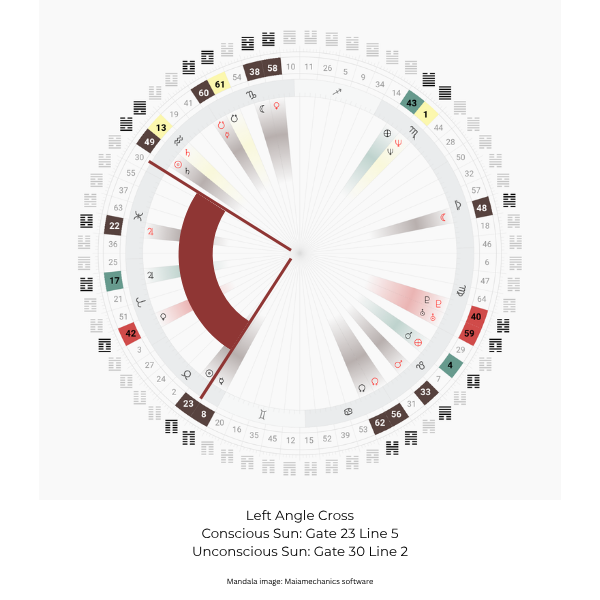
The Left Angle Cross is created by the 5/1, 5/2, 6/2 and 6/3 Profiles.
Where to find the angle on your chart
You’ll see this designation at the beginning of your Incarnation Cross description. For example, you may have the Right Angle Cross of Consciousness or the Left Angle Cross of Refinement. Or, the Juxtaposition Cross of Beginnings. The name of the cross comes from the gates of both conscious and unconscious Sun and Earth activations and the angle is the expression of your Profile’s Lines.
The angle of your Profile is a useful frame for understanding why certain relationships and opportunities in your life have felt fated, versus ones that were simply yours to work out alone. And it helps you make sense of how you’ve habitually engaged with others and the world, in general.
Read yours
Get your free Human Design Insight chart and custom report here and read about your Type, Strategy, Authority, and Profile.