

The 1/3 is a Right Angle Profile, which in practice means this: your path is your own and no one else can shape it. People move through your life, sometimes dramatically, but they’re not the ones steering. That’s you. You’re the one doing the steering — through research and introspection, through trial and error, through the accumulation of your foundation. That’s how your personal destiny is expressed: not a life lived alone, but a life whose direction is entirely yours to work out, one investigation and one bump at a time.
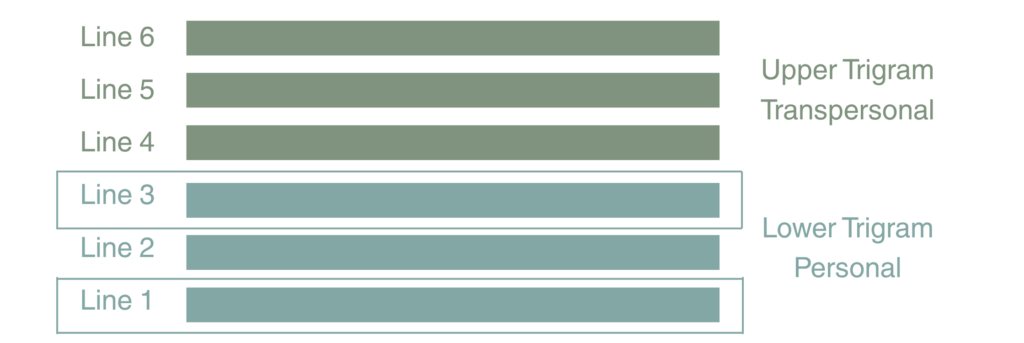
This is the only Profile built entirely from the bottom half of the hexagram. Both Lines are personal — the First Line carries the Investigator archetype, the Third Line carries the Martyr. This makes the 1/3 the most self-referential Profile there is. Nothing about it depends on being seen, called out, or networked into place. It’s expressed in you doing the work, testing the details, and resolving what you find.
The pull toward solid ground
The conscious side of a 1/3 — the First Line — wants to know, deeply, thoroughly, from the ground up. There’s a real discomfort in moving forward on a shaky foundation which can create fear and caution. The unsteadiness is resolved by reading everything, asking the extra question, and probing deeply into a subject long after many people would call it understood. That drive isn’t about proving anything to an audience. A 1/3 will happily spend hours alone with a subject and never mention it to anyone. The purpose is in the knowing, not the sharing.
When misunderstood, this can tip into a kind of permanent preparation, where “not ready yet” becomes a place to live rather than a phase to move through.
The pull toward the deep end
The unconscious Third Line — the Martyr — learns by doing, and it’s not afraid to get it wrong along the way. Bonds get made and broken. What looks like instability is essential experimentation. It’s seen and felt in real time: I’m trying this, and it might not work. A Third Line can look and feel like an anarchist which either attracts or repels others. They possess an innate resilience that allows them to rebound, although how long that takes depends on self-knowledge and self-acceptance.
And, because the Third Line is on the unconscious side, it will likely involve the body in its experimentation more often than the mind. The body wants to test physical and material limits and discover what works and what doesn’t. Finding yourself suddenly, and often painfully, in a relationship that isn’t working can create confusion and shame. The First Line will readily offer conscious criticism of what you ought to have done to prevent it.
Push me, pull you
This is where the two halves of the Profile pull against each other in the most obvious way. The conscious side wants to be sure before it moves. The unconscious side is already moving, and learning from the landing.
Because the conscious seat here belongs entirely to the First Line — not the Third — the not-self version of this Profile doesn’t look like the loud, visible trial-and-error some other Profiles wear openly. It can look like walking on eggshells. It can feel like constant internal vigilance, scanning ahead for what might go wrong before it does. However, no amount of careful study by the First Line prevents the Third Line from bumping into the world as their meant to.
With awareness, informed support, and maturity, this Profile becomes comfortable with its own oppositions. They will investigate, test it in the world, discover what broke or held, then go back and refine the foundation with what was just learned.
What it costs, and what it builds
Because so much of the experimentation happens unconsciously, a 1/3 life can often look messy from the outside. Bonds forming and ending can read, to someone who doesn’t understand the process, like flakiness or inconsistency. It isn’t. It’s closer to the way a scientist runs an experiment. The foundation of the information and details provides the container for the experiment whose results inform the next refinement of the information.
The relationships that tend to serve a 1/3 best are the ones that can hold this without judgment, blame, or shame. Children with this Profile in particular need room to try, get it wrong, and be met with “what did you learn,” not “what did you do wrong.” The alternative — a young 1/3 who gets told every ‘mistake’ or broken bond was a failure — tends to grow into an adult who over-prepares out of fear rather than genuine readiness, which is the one version of this Profile that actually struggles.
Given room to run its own process, though, a 1/3 arrives somewhere solid. They become knowledgeable from having been willing to be wrong first, which is a different and more durable kind of authority. Nobody handed it to them. They built it, step by step, entirely on their own terms, which is, in the end, exactly what a personal destiny was always meant to look like.
Read about Profiles in Human Design here →
Read more: The black, red, and white of your bodygraph — a guide to what conscious and unconscious actually mean in your chart.